0.00/0.00
load high quality audio
Transcript ⇒
Strange Kinships: Second chapter - Walking
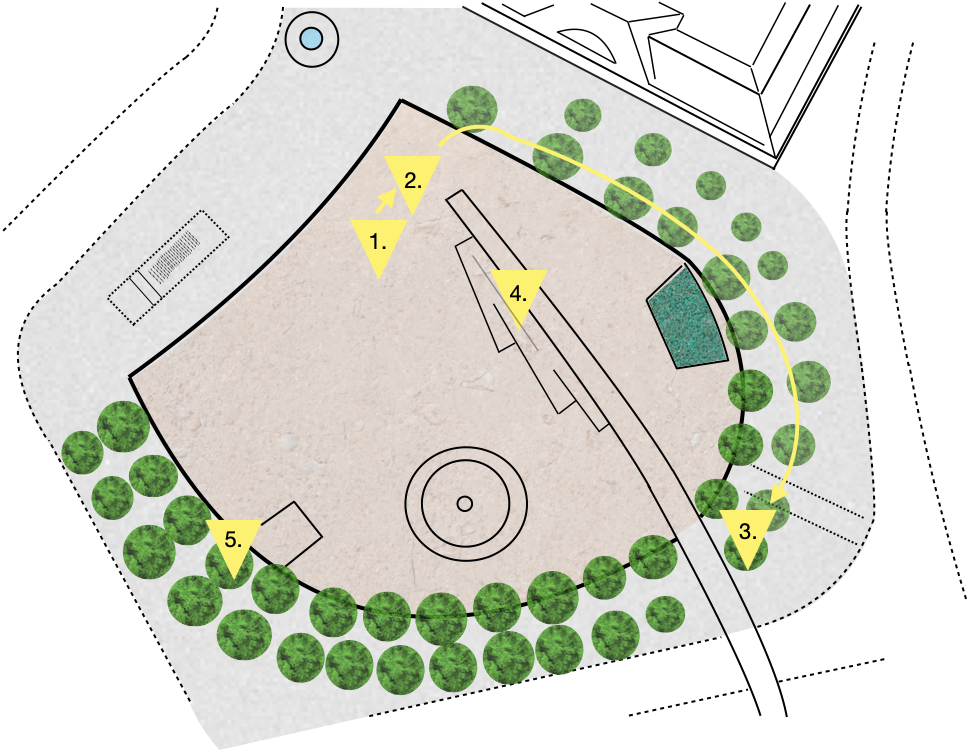
While listening to this chapter you can slowly walk to the next position on the map - number 3, the benches close to the crossroads of the B14 and Filderstraße.
The opening pages of the book focus on how pigeons move on the ground. They consist mostly of carefully dated descriptions of pigeons running for breadcrumbs, jumping on the pavement, or bobbing their heads as they walk.
For example, on the 24th of February 1867 a researcher wrote:
“Hour-long observation of individual. Each step is small, almost delicate, as if the ground must
be tested before it can be trusted. On cobblestones, rooftops, or iron railings, their pace is
more cautious. Movement occurs primarily in a linear fashion; lateral deviations are rare.”
The group also engaged in physical exercises to better understand their research subject. On a
page titled 1st of March’, it says:
“We began the imitation exercises this morning. Heads forward, feet down. Stop. Adjust. Step
again. A strange clarity settles when we do it properly — the body becomes second to the rhythm.
We notice cracks in the pavement we never saw before, the angle of shadows along walls, the
texture of moss on stone.”
As far as we can tell from the often difficult-to-read notes following those exercises, the group developed a theory suggesting that pigeon movements follow a kind of code—rhythmic patterns that could be analysed, and therefore, predicted.
They identified a total of five, what they called, ‘principal walking movements’, which are:
Slow Walk, or: ‚Stroll‘
Turn
Stop
Hop
and Run.
On one of the tapes we found alongside the book, one can hear a team member taking notes on a pigeon’s principal movements. Here is an excerpt from the 45-minute-long section:
“Turn - Stop - Hop - Turn - Stop - Run - Stop - Turn - Walk - Stop - Run - Turn - Stop - Run - Turn - Stop - Run - Stop - Walk - Stop - Turn - Run - Walk - Stop - Walk - Turn - Walk - Stop - Hop”
By now you probably have arrived at position ‘3’ on the map. If so, you can start the next chapter.